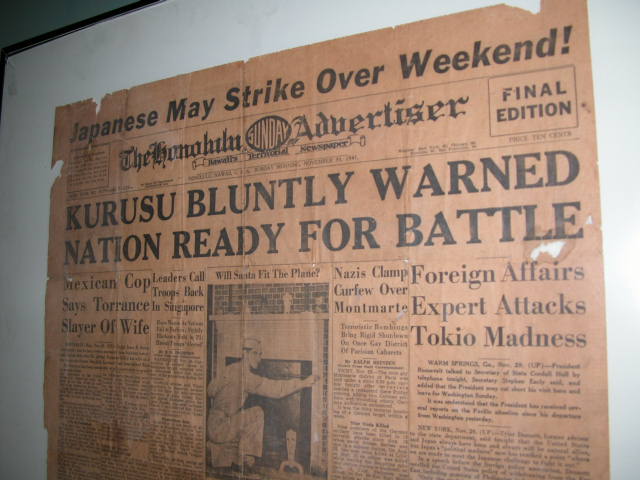
One type of “defensive” war is one that follows a successful provocation of aggression from the desired enemy. This method was used to begin, and repeatedly to escalate, the Vietnam War, as recorded in the Pentagon Papers. Setting aside the question of whether the United States should have entered World War II, in either Europe or the Pacific or both, the fact is that our country was unlikely to enter unless attacked. In 1928 the U.S. Senate had voted 85 to 1 to ratify the Kellogg-Briand Pact, a treaty that bound — and still binds — our nation and many others never again to engage in war.
British Prime Minister Winston Churchill’s fervent hope for years was that Japan would attack the United States. This would permit the United States (not legally, but politically) to fully enter the war in Europe, as its president wanted to do, as opposed to merely providing weaponry, as it had been doing. On April 28, 1941, Churchill wrote a secret directive to his war cabinet:
“It may be taken as almost certain that the entry of Japan into the war would be followed by the immediate entry of the United States on our side.”
On May 11, 1941, Robert Menzies, the prime minister of Australia, met with Roosevelt and found him ” a little jealous” of Churchill’s place in the center of the war. While Roosevelt’s cabinet all wanted the United States to enter the war, Menzies found that Roosevelt,
” . . . trained under Woodrow Wilson in the last war, waits for an incident, which would in one blow get the USA into war and get R. out of his foolish election pledges that ‘I will keep you out of war.'”
On August 18, 1941, Churchill met with his cabinet at 10 Downing Street. The meeting had some similarity to the July 23, 2002, meeting at the same address, the minutes of which became known as the Downing Street Minutes. Both meetings revealed secret U.S. intentions to go to war. In the 1941 meeting, Churchill told his cabinet, according to the minutes: ” The President had said he would wage war but not declare it.” In addition, “Everything was to be done to force an incident.”
Japan was certainly not averse to attacking others and had been busy creating an Asian empire. And the United States and Japan were certainly not living in harmonious friendship. But what could bring the Japanese to attack?
When President Franklin Roosevelt visited Pearl Harbor on July 28, 1934, seven years before the Japanese attack, the Japanese military expressed apprehension. General Kunishiga Tanaka wrote in the Japan Advertiser, objecting to the build-up of the American fleet and the creation of additional bases in Alaska and the Aleutian Islands:
“Such insolent behavior makes us most suspicious. It makes us think a major disturbance is purposely being encouraged in the Pacific. This is greatly regretted.”
Whether it was actually regretted or not is a separate question from whether this was a typical and predictable response to military expansionism, even when done in the name of “defense.” The great unembedded (as we would today call him) journalist George Seldes was suspicious as well. In October 1934 he wrote in Harper’s Magazine: ” It is an axiom that nations do not arm for war but for a war.” Seldes asked an official at the Navy League:
“Do you accept the naval axiom that you prepare to fight a specific navy?”
The man replied “Yes.”
“Do you contemplate a fight with the British navy?”
“Absolutely, no.”
“Do you contemplate war with Japan?”
“Yes.”
In 1935 the most decorated U.S. Marine in history at the time, Brigadier General Smedley D. Butler, published to enormous success a short book called “War Is a Racket.” He saw perfectly well what was coming and warned the nation:
“At each session of Congress the question of further naval appropriations comes up. The swivel-chair admirals…don’t shout that ‘We need lots of battleships to war on this nation or that nation.’ Oh, no. First of all, they let it be known that America is menaced by a great naval power. Almost any day, these admirals will tell you, the great fleet of this supposed enemy will strike suddenly and annihilate our 125,000,000 people. Just like that. Then they begin to cry for a larger navy. For what? To fight the enemy? Oh my, no. Oh, no. For defense purposes only. Then, incidentally, they announce maneuvers in the Pacific. For defense. Uh, huh.
“The Pacific is a great big ocean. We have a tremendous coastline in the Pacific. Will the maneuvers be off the coast, two or three hundred miles? Oh, no. The maneuvers will be two thousand, yes, perhaps even thirty-five hundred miles, off the coast.
“The Japanese, a proud people, of course will be pleased beyond expression to see the United States fleet so close to Nippon’s shores. Even as pleased as would be the residents of California were they to dimly discern, through the morning mist, the Japanese fleet playing at war games off Los Angeles.”
In March 1935, Roosevelt bestowed Wake Island on the U.S. Navy and gave Pan Am Airways a permit to build runways on Wake Island, Midway Island, and Guam. Japanese military commanders announced that they were disturbed and viewed these runways as a threat. So did peace activists in the United States. By the next month, Roosevelt had planned war games and maneuvers near the Aleutian Islands and Midway Island. By the following month, peace activists were marching in New York advocating friendship with Japan. Norman Thomas wrote in 1935:
“The Man from Mars who saw how men suffered in the last war and how frantically they are preparing for the next war, which they know will be worse, would come to the conclusion that he was looking at the denizens of a lunatic asylum.”
The U.S. Navy spent the next few years working up plans for war with Japan, the March 8, 1939, version of which described “an offensive war of long duration” that would destroy the military and disrupt the economic life of Japan. In January 1941, eleven months before the attack, the Japan Advertiser expressed its outrage over Pearl Harbor in an editorial, and the U.S. ambassador to Japan wrote in his diary:
“There is a lot of talk around town to the effect that the Japanese, in case of a break with the United States, are planning to go all out in a surprise mass attack on Pearl Harbor. Of course I informed my government.”
On February 5, 1941, Rear Admiral Richmond Kelly Turner wrote to Secretary of War Henry Stimson to warn of the possibility of a surprise attack at Pearl Harbor.
As early as 1932 the United States had been talking with China about providing airplanes, pilots, and training for its war with Japan. In November 1940, Roosevelt loaned China one hundred million dollars for war with Japan, and after consulting with the British, U.S. Secretary of the Treasury Henry Morgenthau made plans to send the Chinese bombers with U.S. crews to use in bombing Tokyo and other Japanese cities. On December 21, 1940, two weeks shy of a year before the Japanese attack on Pearl Harbor, China’s Minister of Finance T.V. Soong and Colonel Claire Chennault, a retired U.S. Army flier who was working for the Chinese and had been urging them to use American pilots to bomb Tokyo since at least 1937, met in Henry Morgenthau’s dining room to plan the firebombing of Japan. Morgenthau said he could get men released from duty in the U.S. Army Air Corps if the Chinese could pay them $1,000 per month. Soong agreed.
On May 24, 1941, the New York Times reported on U.S. training of the Chinese air force, and the provision of “numerous fighting and bombing planes” to China by the United States. “Bombing of Japanese Cities is Expected” read the subheadline. By July, the Joint Army-Navy Board had approved a plan called JB 355 to firebomb Japan. A front corporation would buy American planes to be flown by American volunteers trained by Chennault and paid by another front group. Roosevelt approved, and his China expert Lauchlin Currie, in the words of Nicholson Baker, “wired Madame Chaing Kai-Shek and Claire Chennault a letter that fairly begged for interception by Japanese spies.” Whether or not that was the entire point, this was the letter:
“I am very happy to be able to report today the President directed that sixty-six bombers be made available to China this year with twenty-four to be delivered immediately. He also approved a Chinese pilot training program here. Details through normal channels. Warm regards.”
Our ambassador had said “in case of a break with the United States” the Japanese would bomb Pearl Harbor. I wonder if this qualified!
The 1st American Volunteer Group (AVG) of the Chinese Air Force, also known as the Flying Tigers, moved ahead with recruitment and training immediately and first saw combat on December 20, 1941, twelve days (local time) after the Japanese attacked Pearl Harbor.
On May 31, 1941, at the Keep America Out of War Congress, William Henry Chamberlin gave a dire warning: “A total economic boycott of Japan, the stoppage of oil shipments for instance, would push Japan into the arms of the Axis. Economic war would be a prelude to naval and military war.” The worst thing about peace advocates is how many times they turn out to be right.
On July 24, 1941, President Roosevelt remarked, “If we cut the oil off , [the Japanese] probably would have gone down to the Dutch East Indies a year ago, and you would have had a war. It was very essential from our own selfish point of view of defense to prevent a war from starting in the South Pacific. So our foreign policy was trying to stop a war from breaking out there.”
Reporters noticed that Roosevelt said “was” rather than “is.” The next day, Roosevelt issued an executive order freezing Japanese assets. The United States and Britain cut off oil and scrap metal to Japan. Radhabinod Pal, an Indian jurist who served on the war crimes tribunal after the war, called the embargoes a “clear and potent threat to Japan’s very existence,” and concluded the United States had provoked Japan.
On August 7th four months before the attack the Japan Times Advertiser wrote: “First there was the creation of a superbase at Singapore, heavily reinforced by British and Empire troops. From this hub a great wheel was built up and linked with American bases to form a great ring sweeping in a great area southwards and westwards from the Philippines through Malaya and Burma, with the link broken only in the Thailand peninsula. Now it is proposed to include the narrows in the encirclement, which proceeds to Rangoon.”
By September the Japanese press was outraged that the United States had begun shipping oil right past Japan to reach Russia. Japan, its newspapers said, was dying a slow death from “economic war.”
What might the United States have been hoping to gain by shipping oil past a nation in desperate need of it?
In late October, U.S. spy Edgar Mower was doing work for Colonel William Donovan who spied for Roosevelt. Mower spoke with a man in Manila named Ernest Johnson, a member of the Maritime Commission, who said he expected “The Japs will take Manila before I can get out.” When Mower expressed surprise, Johnson replied “Didn’t you know the Jap fleet has moved eastward, presumably to attack our fleet at Pearl Harbor?”
On November 3, 1941, our ambassador tried again to get something through his government’s thick skull, sending a lengthy telegram to the State Department warning that the economic sanctions might force Japan to commit ” national hara-kiri.” He wrote: ” An armed conflict with the United States may come with dangerous and dramatic suddenness.”
Why do I keep recalling the headline of the memo given to President George W. Bush prior to the September 11, 2001, attacks? “Bin Laden Determined To Strike in U.S.”
Apparently nobody in Washington wanted to hear it in 1941 either. On November 15th, Army Chief of Staff George Marshall briefed the media on something we do not remember as “the Marshall Plan.” In fact we don’t remember it at all.” We are preparing an offensive war against Japan,” Marshall said, asking the journalists to keep it a secret, which as far as I know they dutifully did.
Ten days later Secretary of War Henry Stimson wrote in his diary that he’d met in the Oval Office with Marshall, President Roosevelt, Secretary of the Navy Frank Knox, Admiral Harold Stark, and Secretary of State Cordell Hull. Roosevelt had told them the Japanese were likely to attack soon, possibly next Monday. That would have been December 1st, six days before the attack actually came. “The question,” Stimson wrote, ” was how we should maneuver them into the position of firing the first shot without allowing too much danger to ourselves. It was a difficult proposition.” Was it? One obvious answer was to keep the fleet in Pearl Harbor and keep the sailors stationed there in the dark while fretting about them from comfortable offices in Washington, D.C. In fact, that was the solution our suit-and-tied heroes went with.
The day after the attack, Congress voted for war. Congresswoman Jeannette Rankin (R., Mont.), the first woman ever elected to Congress, and who had voted against World War I, stood alone in opposing World War II (just as Congresswoman Barbara Lee [D., Calif.] would stand alone against attacking Afghanistan 60 years later). One year after the vote, on December 8, 1942, Rankin put extended remarks into the Congressional Record explaining her opposition. She cited the work of a British propagandist who had argued in 1938 for using Japan to bring the United States into the war. She cited Henry Luce’s reference in Life magazine on July 20, 1942, to “the Chinese for whom the U.S. had delivered the ultimatum that brought on Pearl Harbor.” She introduced evidence that at the Atlantic Conference on August 12, 1941, Roosevelt had assured Churchill that the United States would bring economic pressure to bear on Japan. “I cited,” Rankin later wrote, ” the State Department Bulletin of December 20, 1941, which revealed that on September 3 a communication had been sent to Japan demanding that it accept the principle of ‘nondisturbance of the status quo in the Pacific,’ which amounted to demanding guarantees of the inviolateness of the white empires in the Orient.”
Rankin found that the Economic Defense Board had gotten economic sanctions under way less than a week after the Atlantic Conference. On December 2, 1941, the New York Times had reported, in fact, that Japan had been “cut off from about 75 percent of her normal trade by the Allied blockade.” Rankin also cited the statement of Lieutenant Clarence E. Dickinson, U.S.N., in the Saturday Evening Post of October 10, 1942, that on November 28, 1941, nine days before the attack, Vice Admiral William F. Halsey, Jr., (he of the slogan “kill Japs, kill Japs!” ) had given instructions to him and others to “shoot down anything we saw in the sky and to bomb anything we saw on the sea.”
Whether or not World War II was the “good war” we are so often told it was, the idea that it was a defensive war because our innocent imperial outpost in the middle of the Pacific was attacked out of the clear blue sky is a myth that deserves to be buried.
David Swanson is the author of “War Is A Lie” http://warisalie.org from which this is excerpted.
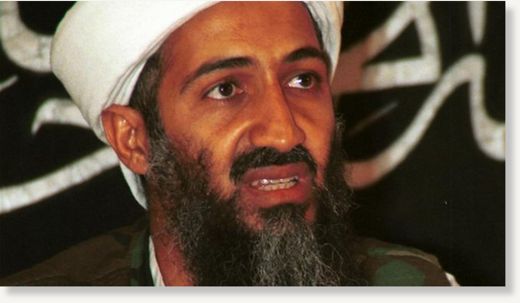
Weeks after the raid that killed Osama bin Laden at this compound in Abbottabad, Pakistan arrested C.I.A. informants who had assisted in the operation.
WASHINGTON — Pakistan’s top military spy agency has arrested some of the Pakistani informants who fed information to the Central Intelligence Agency in the months leading up to the raid that led to the death of Osama bin Laden, according to American officials.
Kuni Takahashi for The New York Times
A casualty of the recent tension between the countries is an ambitious Pentagon program to train Pakistani paramilitary troops to fight Al Qaeda and the Taliban in the northwestern tribal areas.
Pakistan’s detention of five C.I.A. informants, including a Pakistani Army major who officials said copied the license plates of cars visiting Bin Laden’s compound in Abbottabad, Pakistan, in the weeks before the raid, is the latest evidence of the fractured relationship between the United States and Pakistan. It comes at a time when the Obama administration is seeking Pakistan’s support in brokering an endgame in the war in neighboring Afghanistan.
At a closed briefing last week, members of the Senate Intelligence Committee asked Michael J. Morell, the deputy C.I.A. director, to rate Pakistan’s cooperation with the United States on counterterrorism operations, on a scale of 1 to 10.
“Three,” Mr. Morell replied, according to officials familiar with the exchange.
The fate of the C.I.A. informants arrested in Pakistan is unclear, but American officials said that the C.I.A. director, Leon E. Panetta, raised the issue when he travelled to Islamabad last week to meet with Pakistani military and intelligence officers.
Some in Washington see the arrests as illustrative of the disconnect between Pakistani and American priorities at a time when they are supposed to be allies in the fight against Al Qaeda — instead of hunting down the support network that allowed Bin Laden to live comfortably for years, the Pakistani authorities are arresting those who assisted in the raid that killed the world’s most wanted man.
The Bin Laden raid and more recent attacks by militants in Pakistan have been blows to the country’s military, a revered institution in the country. Some officials and outside experts said the military is mired in its worst crisis of confidence in decades.
American officials cautioned that Mr. Morell’s comments about Pakistani support was a snapshot of the current relationship, and did not represent the administration’s overall assessment.
“We have a strong relationship with our Pakistani counterparts and work through issues when they arise,” said Marie E. Harf, a C.I.A. spokeswoman. “Director Panetta had productive meetings last week in Islamabad. It’s a crucial partnership, and we will continue to work together in the fight against Al Qaeda and other terrorist groups who threaten our country and theirs.”
Husain Haqqani, Pakistan’s ambassador to the United States, said in a brief telephone interview that the C.I.A. and the Pakistani spy agency “are working out mutually agreeable terms for their cooperation in fighting the menace of terrorism. It is not appropriate for us to get into the details at this stage.”
Over the past several weeks the Pakistani military has been distancing itself from American intelligence and counterterrorism operations against militant groups in Pakistan. This has angered many in Washington who believe that Bin Laden’s death has shaken Al Qaeda and that there is now an opportunity to further weaken the terrorist organization with more raids and armed drone strikes.
But in recent months, dating approximately to when a C.I.A. contractor killed two Pakistanis on a street in the eastern city of Lahore in January, American officials said that Pakistani spies from the Directorate for Inter-Services Intelligence, known as the ISI, have been generally unwilling to carry out surveillance operations for the C.I.A. The Pakistanis have also resisted granting visas allowing American intelligence officers to operate in Pakistan, and have threatened to put greater restrictions on the drone flights.
It is the future of the drone program that is a particular worry for the C.I.A. American officials said that during his meetings in Pakistan last week, Mr. Panetta was particularly forceful about trying to get Pakistani officials to allow armed drones to fly over even wider areas in the northwest tribal regions. But the C.I.A. is already preparing for the worst: relocating some of the drones from Pakistan to a base in Afghanistan, where they can take off and fly east across the mountains and into the tribal areas, where terrorist groups find safe haven.
Another casualty of the recent tension is an ambitious Pentagon program to train Pakistani paramilitary troops to fight Al Qaeda and the Taliban in those same tribal areas. That program has ended, both American and Pakistani officials acknowledge, and the last of about 120 American military advisers have left the country.
American officials are now scrambling to find temporary jobs for about 50 Special Forces support personnel who had been helping the trainers with logistics and communications. Their visas were difficult to obtain and officials fear if these troops are sent home, Pakistan will not allow them to return.
In a sign of the growing anger on Capitol Hill, Representative Mike Rogers, a Michigan Republican who leads the House Intelligence Committee, said Tuesday that he believed elements of the ISI and the military had helped protect Bin Laden.
A startling Federal Security Service (FSB) report on the 22 July massacre in Norway states that two-days prior to this catastrophic attack Norwegian Prime Minister Jens Stoltenberg [photo top right with Putin] placed an “urgent” call to Putin “begging” Russia’s leader to help stop the events that left nearly 100 innocent civilians dead.
According to the FSB, Stoltenberg first learned of this plot against his country this past Wednesday after reading a “top secret” report prepared for him by the Norwegian Intelligence Service (NIS) on the late March computer attack against Norway’s top military leaders that showed them involved in a conspiracy with Britain’s MI5 Security Service and the United States Central Intelligence Agency (CIA) to launch a “two-phase” attack upon Norway modeled after false-flag operations in both Australia and America in the mid-nineties.
The false-flag operations being modeled in Norway were based on the 19 April 1995 bombing attack on the Oklahoma Alfred P. Murrah Federal Building said caused a lone right-wing Christian fundamentalist who used a fertilizer bomb that killed 168, and the 28 April 1996 Port Arthur massacre in Australia where a lone gunman killed 35 mainly because the police failed to show up in a timely manner, and which the aftermath of both attacks caused a fundamental shift away from freedoms and liberties these peoples once enjoyed.
The FSB further reports that this false-flag attack on Norway was a “clear textbook example” of an Operation Northwoods operation designed and prepared by US Military experts. Operation Northwoods was a series of false-flag proposals that originated within the United States government in 1962. The proposals called for the CIA or other operatives, to commit acts of terrorism in US cities and elsewhere in order to influence public opinion and have been used by many Western governments over these past five decades.
FSB experts note in this report that the false-flag attacks on Norway further mirror those of Oklahoma City and Port Arthur in: 1.) A large vehicle holding a powerful fertilizer bomb was able to gain undetected entrance to a protected government centre; 2.) The armed police response to an ongoing massacre of civilians was delayed for reasons still not explained; 3.) A lone suspect has been indentified as the sole perpetrator of the attacks contrary to witness statements that more people were involved; 4.) The lone suspect is denied the right to an open hearing before the public.
This report also notes that within hours of these attacks occurring, a “virtual flood” of information relating to the suspected mastermind of this massacre was released indentifying him as a “blond-haired blue-eyed” Norwegian named Anders Behring Breivik and caricatured as a right-wing Christian fundamentalist. A person which (coincidentally?) the United States had warned barely 24-hours earlier in a video released by their Department of Homeland Security (DHS) was the type of person they feared most would carry out such a terror attack.
The critical problem with the flood of information being released on/or by Breivik, the FSB asserts, is to what is true and what isn’t. This issue was made even more important by American computer experts noting that the Facebook page said belonging to Breivik appears to have been faked, and as they note:
1: Why is there a version of Anders Behring Breivik’s Facebook profile not showing Christian / Conservative? Even Google’s cache of the Facebook profile retrieved on Jul 22, 2011 23:52:36 GMT supports this factor.
2: How was Christian / Conservative added prior to the profile being removed from Facebook? If our PDF was printed out/saved at Jul 23 01:39 GMT, and the profile was deleted soon afterwards by Facebook, how was a detained Anders Behring Breivik able to change it?
3: Which then needs to be asked, Who had access to in changing the Profile before it was removed?
Aside from the “most likely” faked Facebook page, Breivik is, also, said to have posted an astonishingly detailed 1,500-page manifesto and video [view on left] titled “2083: A European Declaration Of Independence” datelined “London, 2011” on the Internet that claims “the number of Muslims in Western Europe is “reaching critical mass” and there is a core of Cultural Communist elites in Western Europe who really want to destroy Western civilization” and that “Europe will burn again.”
Breivik further said he regarded himself as a successor to the medieval Knights Templar, and claimed to have been recruited at a meeting in London in April 2002, which was hosted by two English extremists and attended by eight people in total. Breivik’s ties with London, and hence MI5, was due to his father being a top economist at the Norwegian Embassy in London where Anders was described as a “mummy’s boy” and “privileged” son of an elite liberal family. [Especially interesting to note about this description of “mummy boy” Breivik is his stating that the main target of his attack was Norway’s “Mother of the Nation” and former Prime Minister Gro Harlem Brundtland.]
The FSB, however, in this report disputes Breivik’s ties with the Knights Templar stating, instead, that this false-flag attack has provided an “ancillary benefit” to the West’s royal and banking elite classes in discrediting this ancient order as “open warfare” between them looms, and as we had detailed in our 21 July report “Murdoch Threat To Expose Obama As “Christ-Child” Ignites Western Fury.”
To the reason(s) behind this attack, this FSB report states, is a “desperate attempt” by British, European Union and American banking interests to force Norway into their “union” [Norway is not a member of the EU] in order to loot their Sovereign Wealth Fund of its estimated $1.5 Trillion in wealth which without the entire Western economy may collapse. Important note, the FSB says, is that what is being done to Norway has already been done to Libya when in what is now called the “Financial Heist of the Century” these same elites launched an unprovoked attack upon this North African nation and promptly looted it of nearly $150 Billion of their Sovereign Wealth Fund in order to sustain their crumpling empire.
Though there is more, much more, contained in this FSB report that we will have to examine further in order to report to you on it accurately upon it. So, and in closing this first report on this tragedy we’ll end with some of the words attributed to Breivik that in light of what this whole issue is being made out to be do, indeed, note us paying attention to them:
“A majority of the people I know support my views, they are just apathetic. They know that there will be a confrontation one day, but they don’t care because it will most likely not happen within the next two decades I am a pioneer in this fight, and I have no doubt whatsoever that we will see a political shift in our favor sooner than we might expect. It might look grim at the moment, but we are after all fighting a self-defeating ideology (Cultural Communism that is, not Islam). The only pragmatic approach towards Islam is to isolate it to Muslim countries once we are in a position to do so — on September 11th, 2083.”
The 1,500-page manifesto written by Anders Behring Breivik. He claims links with far-right groups, including the English Defence League. Photograph: AFP/Getty
Anders Behring Breivik, the man behind the Norway killings that left 93 people dead, began his journey in extremist rightwing politics at a small meeting in London in 2002, according to his online manifesto, and may have attended a far right demonstration in the UK as recently as last year.
In a 1,467-page document that contains chilling details of his preparations for Friday’s attacks, Breivik outlines his UK links, claiming he met eight other extremists from across Europe in London in 2002 to “re-form” the Knights Templar Europe – a group whose purpose was “to seize political and military control of western European countries and implement a cultural conservative political agenda”.
The manifesto, signed “Andrew Berwick London 2011”, contains repeated references to his links to the UK far right group the English Defence League. On Sunday there were unconfirmed reports from one of the organisation’s supporters that the 32-year-old had attended at least one EDL demonstration in the UK in 2010.
“[B]ar one or two doubt the rest of us ever met him, altho he did come over for one of our demo in 2010 … but what he did was wrong,” said an EDL member online.
In the manifesto titled 2083: A European Declaration of Independence, Breivik writes: “I used to have more than 600 EDL members as Facebook friends and have spoken with tens of EDL members and leaders. In fact; I was one of the individuals who supplied them with processed ideological material (including rhetorical strategies) in the very beginning.”
The EDL – which has staged a series of street demonstrations, many of which have turned violent, since it was formed two years ago – issued a statement on Sunday condemning the attacks in Norway. It added that the league was a peaceful organisation which rejected all forms of extremism.
“There has never been any official contact between him and the EDL, our Facebook page had 100,000 supporters and receives tens of thousands of comments each day,” it added. “And there is no evidence that Breivik was ever one of those 100,000 supporters.”
The group pointed out that Breivik was critical of the EDL in the “manifesto”, describing it as “dangerously naive”.
Another UK-based organisation, Stop Islamisation of Europe , told Reuters that Breivik had tried to join their Facebook group but had been rejected over his apparent neo-Nazi links. However, they said it was possible he had attended one of its demonstrations.
Emblazoned with a red Iron Cross and published in English, the manifesto appeared online a few hours before the attacks. It appears to be a mixture of bomb-making manual, diary and political rant against a range of perceived enemies from “cultural Marxists” to Muslims, liberals and journalists.
It includes an detailed diary covering the 82 days leading up to the attacks which reveals Breivik’s mood swings, his attempts to make explosives on a remote farm and even his favourite DVDs.
On the day he was to kill 93 people Breivik wrote: “The old saying; ‘If you want something done, then do it yourself’ is as relevant now as it was then.” A few hours later he added: “I believe this will be my last entry. It is now Fri July 22nd, 12.51.” Berwick signed off “AB Justiciar Knight Commander, cell 8, Knights Templar Europe.”
The document details Breivik’s isolated life on the farm as he carried out meticulous preparations for the attack, testing explosives and obtaining weapons.
It reveals an obsession with the Crusades and a supposed threat to Christian Europe posed by Muslim immigrants and mainstream political leaders. Breivik predicts a European civil war will take place in three stages, ending in 2083 with the execution of “cultural Marxists” and the deportation of all Muslims.
Friday’s attack was being planned for at least 18 months, according to the document. Breivik expresses concern that preparations for the attack and the manifesto would alert the security services.
“I do fear sometimes that my endeavours relating to the research of the book, and acquisitions of these addresses has resulted in me being put on various watch lists,” an entry dated March 2010 reads. “The question is; have they flagged me? I guess I will find out eventually.”
In one section Breivik argues that is better to kill civilians than those who would offer more resistance, writing: “It is much more rational and pragmatical to focus on the easier unprotected targets instead of sacrificing good men on an impossible target … we should target unprotected category A and B traitors first and foremost.”
He goes on to outline plans for a possible attack on a gathering of investigative journalists which he says is one of the “most attractive” potential targets.
“To illustrate; in Norway, there is an annual gathering … where the most notable journalists/editors from all the nations media/news companies attend (500 delegates – 98% of them are considered ‘quality category B traitor targets’.”
He sets out a detailed plan for a car or lorry bomb “covered with layers of projectiles for maximum damage” followed by an attack with rifles and flame throwers.
Breivik advocates attacks on traitors across Europe. “[W]e should under normal (optimal) circumstances not exceed (per 2010) aprox. 45 000 dead and 1 million wounded cultural Marxists/multiculturalists in Western Europe.”
Anti-racist groups in the UK said they were not aware of the Knights Templar Europe and cautioned that Breivik may have made up some or all of the details.
Gurgaon: The country’s elite NSG has embarked on an ambitious project to prepare new-age commandos equipped with high-end weapons to undertake specialised counter- terrorism and counter-hijack operations through land, air and water.
The force, known as the ‘black cats’, will churn out close to 2,000 commandos by 2015-16. They will be completely independent to operate in a hostile environment with the help of artificial intelligence gadgets being developed for them indigenously by DRDO and other premier organisations.
“The National Security Guard is now on the verge of a quantum jump. We have set our plans to prepare a modern commando. A five-year plan has been activated. It primarily concentrates on the commando…a commando who will be independent to operate,” NSG DG R K Medhekar said.
He was talking to reporters on the occasion of NSG’s Raising Day at Manesar garrison here.
The plan has been made keeping in mind that a commando should be independent when he operates…his weapon, his body armour, communication devices, body wearable computer. Water and food should be with him on his body. Some elements in this regard are already under trial and we hope to get the first batch of such new age commandos by 2015-16, Medhekar said.
The NSG chief said two battalions (2000 commandos) will emerge out once the trials and tests are complete and they will be able to operate from air, water and land.
Medhekar said the modern commando will be on par with the men of other elite special forces of the world as “terrorists and their designs are advancing with time.”
“This (developing of modern commando) requires a lot of work and developing of data…we are doing it in collaboration with DRDO and artificial intelligence institutes. We have to depend on indigenous methods for this as no one shares their expertise in this field,” Medhekar said.
The NSG DG said the new age commando would be able to transmit real-time images of a crucial operation like the one that killed global terrorist Osama bin Laden in Pakistan’s Abbottabad early this year.
Medhekar said the government has approved a host of sophisticated weapons and other logistical requirements which include corner-shot weapons and advanced sniper guns.
“Some of the finest equipment for bomb disposal teams and digital communication has been procured,” he said.
“Our sanction for manpower has been approved keeping in mind our expansion because of four new hubs and two regional centres that were announced in the aftermath of the 2008 Mumbai terror attacks. The permanent structure facilities will soon be inaugurated in all the hubs,” he said.
The NSG has created the hubs in Mumbai, Kolkata, Chennai and Hyderabad including a regional centre each in Hyderabad and Kolkata after 26/11 terror strikes.
The West Bengal government recently approved a 35-acre land in Rajarhat area of Kolkata for the regional centre of the force. However, this is much less land than what NSG was looking for in the eastern metropolis as compared to the 600-acres land for a similar centre which has been handed over by the state government in Hyderabad to the NSG.
The NSG chief also said his commandos will have fresh training exchanges with other special forces of the world including with the Federal Bureau of Investigation (FBI), Los Angeles Police Department (LAPD) and the US department of Defense.
Earlier, Union Minister of State for Home M Ramachandran, who was the chief guest, said “responsibilities of the NSG have increased manifold” in the current security scenario and the force should be prepared to meet these expectations.
Talk to Air Force pilots about drones and they’ll be quick to correct you on the nomenclature. The flying robots aren’t really “unmanned,” they’ll stress, but “remotely piloted,” since a real live human being is at the controls far away. But the Navy? Navy aviators want their drone to really fly themselves.
Take the X-47B experimental killer drone made by Northrop Grumman, the first drone intended to fly off an aircraft carrier. At the Navy League’s annual Sea Air Space convention outside Washington, Northrop and the Navy and unveiled new details about the tailless, triangular plane and their schedule to get it flying off a carrier. Rule number one of the X-47B: it’s not “remotely piloted.”
Put the phrase “remotely piloted” out of your mind, says Janis Pamiljans, a Northrop vice president who handles the company’s Unmanned Combat Air System Demonstration (UCAS-D) portfolio. When it gets on board an aircraft carrier, it’s going to be controlled by a “mouse click,” Pamiljans says. The click of a mouse will turn on the engines. Another will get it to taxi. Keep clicking, and the plane will “take off and come home.”
No joysticks and no pilot controlling it from a metal box somewhere. Just push-button operations and 3.4 million lines of software code and functionality to control the X-47B. “That’s about it,” Pamiljans deadpans.
Not that that’s an understatement or anything. Pamiljans’ counterpart from the Navy, Capt. Jaime Engdahl, tells reporters assembled for a briefing on the future of the plane — which took its first flight at Edwards Air Force Base in February — that if there’s one thing he wants to impress upon the crowd is that there’s something about landing a plane on a ship at sea “that’s special.” It’s not just a floating airstrip, it’s a delicate, precise minuet. And that means the autonomous aspects of the plane have to be suited to the carrier’s crew.
“How we integrate the unmanned vehicle, maneuver it to taxi, its stealth characteristics — it’s a big learning thing,” Engdahl says.
That’s why, by “early to mid 2013,” the plane’s program managers will be simulating carrier operations for a “seamless integration,” using Nimitz-class carrier decks at Pautuxent River, Md., to get both the X-47B and the carriers ready for one another. They’ll be practicing launch operations, “hard” landings, datalink downloads from the plane to the crews, everything. Taxi controllers will have display units mounted on their arms that send radio frequencies to direct the plane across the decks.
The schedule for the plane has slipped: the Navy used to anticipate carrier launches for the X-47B as early as this year. As the schedule stands now, the last round of tests will occur by 2014, when the plane will practice mid-air refueling and successful landing back on a carrier — another mouse click, one that effectively means, “X-47B, find your tanker,” Pamiljans says.
Necessarily, that’s going to mean “a high level of redundancy and reliability,” Engdahl says, or the program’s going to be a crash-prone disaster. There are only two X-47Bs in existence, and Northrop doesn’t plan to build any more.
The one thing they’re not going to test? Weapons. Nothing about the next several years’ worth of testing will involve weapons mounts or releases, Engdahl and Pamiljans both insist. That’s despite the fact that the plane can carry up to 4500 lbs. worth of payload in its twin weapons bays. And that it’s supposed to be a killer. (Even if it moonlights as a stadium-ready rock-n-roller in the video above, produced by Northrop.)
Both Engdahl or Pamiljans accordingly ducked a question about how the plane’s boasted autonomy will handle any weapons releases. Everyone who fears Skynet generally blanches at the idea of robots firing weapons on their own. But the X-47B will be “on autopilot 100 percent of the time,” Engdahl says. Nothing left to do but welcome our robot overlords.
For the second year in a row, more American soldiers—both enlisted men and women and veterans—committed suicide than were killed in the wars in Iraq and Afghanistan. Excluding accidents and illness, 462 soldiers died in combat, while 468 committed suicide. A difference of six isn’t vast by any means, but the symbolism is significant and troubling. In 2009, there were 381 suicides by military personnel, a number that also exceeded the number of combat deaths.
Earlier this month, military authorities announced that suicides amongst active-duty soldiers had slowed in 2010, while suicides amongst reservists and people in the National Guard had increased. It was proof, they said, that the frequent psychological screenings active-duty personnel receive were working, and that reservists and guardsmen, who are more removed from the military’s medical bureaucracy, simply need to begin undergoing more health checks. This new data, that American soldiers are now more dangerous to themselves than the insurgents, flies right in the face of any suggestion that things are “working.” Even if something’s working, the system is still very, very broken.One of the problems hindering the military’s attempt to address soldier suicides is that there’s no real rhyme or reason to what kind of soldier is killing himself. While many suicide victims are indeed afflicted with Post Traumatic Stress Disorder after facing heavy combat in the Middle East, many more have never even been deployed. Of the 112 guardsmen who committed suicide last year, more than half had never even left American soil.
“If you think you know the one thing that causes people to commit suicide, please let us know,” Army Vice Chief of Staff General Peter Chiarelli told the Army Times, “because we don’t know what it is.”
In 2004, the Bush administration flew twenty billion dollars of shrink-wrapped cash into Iraq on pallets. Now the bulk of that money has disappeared. The funds flown into the war zone were made up of surplus from the UN’s oil-for-food program, as well as money from sales of Iraqi oil and seized Iraqi assets. Recent estimates had the amount of missing money at about $6.6 billion, but according to Al Jazeera, Iraqi Parliament Speaker Osama al-Nujaifi says the figure is closer to three times that amount.
Officials were supposed to distribute the money to Iraqi government ministries and U.S. contractors tasked with the reconstruction of Iraq, but it now appears that the bulk of the cash was stolen in what may be one of the largest heists in history.
The Iraqi government argues that U.S. forces were supposed to safeguard the cash under a 2004 agreement, making Washington responsible for the money’s disappearance. Pentagon officials claim that given time to track down the records they can account for all of the money, but the U.S. has already audited the money three times and no trace of what happened to it can be found.
Al Jazeera says that it has been unable to find any documents whatsoever accounting for the money’s disappearance. Some believe that U.S. officials absconded with the money, but it’s more likely, sources say, that corrupt Iraqi officials used the funds to line their own pockets.
To date, it’s estimated that the Iraq War has cost the United States more than a trillion dollars.
‘Now what is [Vice President] Omar Suleiman’s position? No one knows that he remains in his position as vice president. The government of course is going to be changed. But the top brass, all of the members of this military council, [are] all very close hand-picked generals picked by Mubarak over the years. And obviously screened by CIA. So I still have reservations, we’re just starting. We have succeeded in a very important step which is getting rid of Mubarak. But Mubarak for the past five years has not been governing this country.
He’s been sitting in Sharm el-Sheikh where he is now; he has been for five years. He hardly ever comes to Cairo. It has been run by General Omar Suleiman who was vice president until a couple of hours ago, may still be. It was run, from security point of view and from a foreign policy point of view by Omar Suleiman. He is a close friend of the Israelis and of the Americans. Nothing has changed.’
I have been watching the understandable euphoria in Egypt live on Al Jazeera television, but please, there must be a sense of perspective here – and urgently.
There has been NO REVOLUTION so far – a despicable tyrant has gone, but the army that imposed the will of that despicable tyrant for 30 years is now in charge and the Egyptian army is not only controlled by the US, it is funded by massive American military ‘aid’ – second only in scale to Israel.
It is true that the army didn’t fire on the demonstrators as it would have done before, but it did so at the time that its masters in America were calling for Mubarak to step down, in effect, and for the protestors to be left alone. Why did the US government do this after supporting the tyrant for 30 years? Because they want ‘regime change’ in Egypt as part of a domino effect across the whole Middle East to advance a much bigger agenda.
Mubarak’s demise was announced by his vice-president, the US puppet, Omar Suleiman, the head of the vicious and murderous Egyptian General Intelligence Directorate that as well as controlling the population through sheer terror also accepted Muslim detainees arrested by the US to be tortured in Egypt in ways that would have been illegal in America – the so called ‘Extraordinary Rendition’.
And waiting in the wings is America’s (the Illuminati’s) man, Mohamed ElBaradei, who is on the Board of Trustees of the International Crisis Group of Rothschild front-man, George Soros, and his associate Zbigniew Brzezinski, who specialise in triggering and manipulating ‘peoples’ revolutions’ to change regimes while hiding the force that is really behind it all.
It is wonderful to see the joy of the Egyptian people at the end of Mubarak, but the job is only half done and if it ends here nothing will change. ‘Peoples’ revolutions’ covertly inspired by the money and agencies of George Soros in Georgia, Ukraine, the Czech Republic and elsewhere also has their moments of enormous euphoria when a regime fell, but any revolution of the people can only be judged by what replaces that which is removed.
Others have been deeply disappointed and disillusioned in the past and if Egypt is not to go the same way the focus and determination must not be lost – and ElBaradei must not prevail, nor anyone else who represents the forces of control and suppression.
Out of the frying pan into the fryer is not a revolution.
Team Spirit (1976–1993) — Annual joint exercise with South Korean forces.
Dwarka(1965)— Pakistan Navy’s attack on the Indian coastal town of Dwarka on 7 September 1965. This was the first use of a Navy in the Indo-Pakistan Wars.
Reforger — Annual American exercise to “return forces to Germany”.
Retail (1946) — British clearance of naval mines laid in Albanian waters.
Silver (1949) — covert British communications tap in Austria
Banner (1969–2007) Deployment of British troops to Northern Ireland. To prevent sectarian killings and support the Police (RUC). Op Banner resulted in over 700 British Armed Forces deaths and 303 Police deaths at the hands of the Irish Republicans
Operation Danube (1968) — Warsaw Pact invasion to halt Czechoslovakia’s “Prague Spring” reforms
The track down operation (1967) — that capture and executed Che Guevara
Operation Condor (1970’s) — — A campaign run by then South American Military Dictatorships’ intelligence services with United States’ support, which goal was extrajudicial and secretly, find, capture and eliminate political dissidents who, had succeeded to escape political repression in their homelands but could be found in any of these other countries.
Operation Pluto (1961) — plan to invade Cuba and overthrow its’ government using an CIA-trained force of Cuban exiles.
Mongoose (1962) — plan for information gathering, sabotage, civil insurrection and the overthrown of the Cuban government.
Phibriglex (1962) — US plan and mock invasion by its armed forces of a Caribbean island. The exercise took place on Vieques and the purpose of the mock invasion was to overthrow a fictitious leader called “Ortsac”, whose name was, in fact, Castro spelled backwards. It occurred in August, shortly before the Cuban Missile Crisis. It is also known by the names Operation Ortsac, Operation Swift Strike II and Exercise Phibriglex-62.
Cubana Flight 455 (1976) — a Cuban civilian flight from Barbados to Jamaica that was brought down by a terrorist attack did by CIA anti-Castro Cuban exiles and members of the Venezuelan secret police.
Amphibian (2001) — South African deployment to the Democratic Republic of the Congo and Rwanda of observers to verify implementation of the Pretoria Agreement.
Astute (2006) — Deployment of Australian military forces to East Timor following the May 2006 civil unrest.
Citadel — Australia’s contribution to the United Nations Mission of Support in East Timor (UNMISET). Later ongoing peacekeeping actions were known as Operation Tanager.
Scorched Earth — Or Operasi Sapu Bersih in Indonesian, also known as Operation Clean Sweep; campaign of violence and arson allegedly committed by the TNI-supervised pro-integration militias following the 1999 United Nations supervised plebiscite.
Spitfire — Evacuation of foreign nationals from East Timor by Australian defence assets, as a result of post-referendum violence.
Operation Otkos 10 (end Oct-Nov 1991) — Croatian actions against rebel Serbs and regular Serbian forces on area from Mount Bilogora to Mount Papuk (on west of Slavonia)
Able Sentry (1993–94) — Berlin Brigade deployed as part of Multi-National United Nations Protection Forces (UNPROFOR) to the Republic of Macedonia to establish Camp Able Sentry and monitor sanctions imposed by NATO against Serbia/Kosovo. *This mission was later taken over by the (then) Germany-based, 3rd Infantry Div (Mech)
Essential Harvest(2001) — month-long NATO mission of disarming ethnic Albanians in Macedonia
Forage — Canadian contribution to NATO’s Essential Harvest
Kinetic — Canada’s contribution to NATO’s mission KFOR to secure Kosovo and Macedonia and to provide humanitarian needs to displaced persons
Echo — Canada sending air forces to Aviano, Italy to enforce a no-fly zone over Balkan region (UNSFOR and UNKFOR)
Mountain Storm — Macedonian special police operation against Albanian extremists (2007).
Relex (2001) — Australian defence force operations to secure Australia’s northern maritime approaches against illegal immigration. Reactivated in 2004 as Operation Relex II.
Exercise Unified Spirit — large NATO exercise held every two years to train the armed forces of member nations in joint and combined operations.
Operation Vijay (1999) — Indian operations against Pakistan during the Kargil war that took place between May and July 1999 at Kargil district, Jammu & Kashmir, India.
Century (1996) — ill-fated Essex police / Royal Ulster Constabulary operation to pressure persons of interest for information about a drug-related triple murder.
Gaddafi was being demonised by the Reagan-Father Bush administration (the Rothschilds) in the 1980s when the CIA and Mossad led a campaign to destabilise Libya that mirrors what has happened in 2011. Newsweek reported on August 3rd, 1981:
‘The details of the plan were sketchy, but it seemed to be a classic CIA destabilization campaign. One element was a “disinformation” program designed to embarrass Kaddafi and his government. Another was the creation of a “counter government” to challenge his claim to national leadership. A third — potentially the most risky — was an escalating paramilitary campaign, probably by disaffected Libyan nationals, to blow up bridges, conduct small-scale guerrilla operations and demonstrate that Kaddafi was opposed by an indigenous political force.’
Sound familiar? That was 30 years ago.
But so many just buy the lie no matter what the era or generation. As Adolf Hitler said: ‘Make the lie big, make it simple, keep saying it, and eventually they will believe it.’ And his propaganda chief, Joseph Goebbels, said: ‘The most brilliant propagandist technique will yield no success unless one fundamental principle is borne in mind constantly – it must confine itself to a few points and repeat them over and over. Hitler also said, with equal relevance: ‘What luck for the rulers that men do not think.’
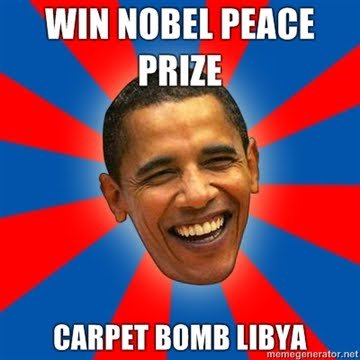
NATO planes pepper-bombed Tripoli in support of the ‘rebels’ on the ground. Thousands of the very civilians that the UN resolution said should be protected were killed in the process. But we hear nothing of this in the mainstream media and precious little of the murder and executions of Gaddafi supporters by the ‘rebels’ throughout the conflict and after they entered Tripoli.
The emphasis is always on alleged executions and killings of rebel supporters by Gaddafi’s forces. No doubt some of these claims are true, but where is the balance? There is none, and Syria is now being demonised to go through the same process of demonise, invade, conquer, control. Richard Haas, president of the Illuminati Council on Foreign Relations which directs US foreign policy, has admitted that the NATO bombing of Libya was not about protecting civilians, but removing Gaddafi. He also called for an ‘international force’ to occupy the country and ‘maintain order’.
It is the same rhetoric, the same blueprint, which we have seen in every other country ‘liberated’ by the architects of tyranny. It really is goodbye Libya: rest in peace. The United States and its conscripted NATO allies are not going to walk away and leave Libya to the Libyans. It is an occupation force to pillage the oil resources and the banking system, and it was always going to be.
The board of a study centre at the London School of Economics with links to the Gaddafi regime in Libya includes no fewer than four men who have served at the highest levels of the British Intelligence community.
As well as Sir Mark Allen, former head of MI6’s Middle East desk, there are two ex-chairmen and one former member of the Joint Intelligence Committee – the top-secret Cabinet Office body which coordinates all national security assessment for ministers.
Gordon Barrass, visiting professor at the centre – known as LSE Ideas – was a member of the JIC in the last years of the Cold War and is a Soviet expert. Sir Colin Budd was chairman of the JIC in 1996-97. And between 2005 and 2007 Sir Richard Mottram was Cabinet Office permanent secretary for intelligence, security and resilience, and chairman of the JIC.
LSE Ideas is at the centre of a storm over the university’s decision to help Colonel Gaddafi seek international acceptance before the Libyan uprising and to accept enormous amounts of cash from his son Saif. Its chairman, formerly one of Tony Blair’s most senior political aides, sought yesterday to distance himself from the scandal.
Sir David Manning is the ex-ambassador to Washington who was Mr Blair’s confidant throughout the run-up to the Iraq war.
He claimed to have no more than a ‘very small association’ with the LSE, which controversially accepted a £1.5million donation from Saif a year after awarding him a questionable PhD. Asked if the LSE should have taken Saif’s cash, Sir David said: ‘It wasn’t a huge sum of money. It’s a pity probably it happened, but if you were trying to draw Libyans into the mainstream of international life then I suspect that was the motivation.’
Angry students are demanding a full-scale inquiry into the Libyan funding controversy which has heaped embarrassment on the LSE as more links emerge between the Ideas centre, the Blair government, security services and big business.
Formed three years ago, the Ideas centre had an income of just over £2.5million between 2008 and 2010, with 94 per cent coming from ‘external sources’. The LSE claims the centre – whose stated aim is ‘understanding how today’s world came into being and how it may be changed’ – has received no money from Libya.
Aside from Sir David, the Ideas advisory board members include Mr Blair’s ex-chief of staff Jonathan Powell, former Foreign Office Minister Baroness Symons – forced to stand down from Libya’s National Economic Development Board this week – and Sir Mark Allen, a former MI6 spy who played a pivotal role in bringing Blair and Colonel Gaddafi together and lobbied ministers to secure the release of the Lockerbie bomber.
Whenever the military rolls out a new robot program, folks like to joke about SkyNet or the Rise of the Machines. But this time, the military really is starting to venture into robot-apocalypse territory: swarms of little semi-autonomous machines that can team up to manufacture complex objects (including, presumably, more robots).
That’s right, the only thing scarier than a swarm of intelligent military mini robots is a swarm of intelligent military mini robots in control of the means of production. And your Navy is hard at work on making it a reality.
The U.S. Navy recently issued a proposal for aspiring mad scientists to build it “a coordinated and distributed swarm of micro-robots” capable of manufacturing “novel materials and structures.”
This isn’t heavy industry, though. They want the robot swarm to use desktop manufacturing — a technology that allows you to “print” 3-D objects using equipment that can fit on your desk and be programmed with nothing more sophisticated than your own laptop.
In its more benign uses, desktop manufacturing takes the form of products like Makerbot, which lets users fabricate cool 3-D objects out of plastic. In the hands of intelligent robots, though, think of this more as the Easy-Bake Oven of the robot apocalypse.
The proposal says the mini manufacturers will be able to “pick and place, dispense liquids, print inks, remove material, join components” and “move cooperatively” to not just make things, but assemble them, as well.
And what exactly will they make? The Navy lists a number of examples like “multifunctional materials” and “metamorphic materials” but its mention of “programmable materials” really caught our ear.
Darpa, the Defense Department’s far-out advanced research wing, has previously experimented with “programmable materials” to create shape-shifting machines like the self-folding origami robot that can change into a small plane and boat.
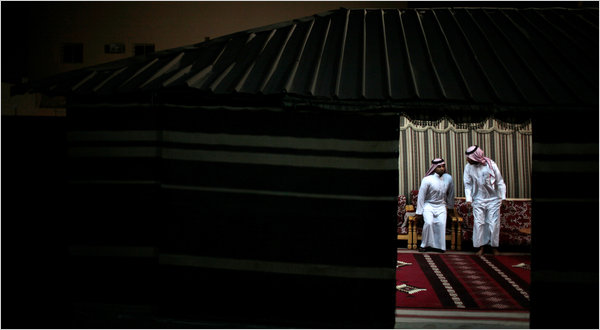
Former Saudi political prisoners gathered recently in Riyadh to discuss politics. Some former political prisoners feel embittered by the public’s lack of support.
RIYADH, Saudi Arabia — As one nation after another has battled uprisings across the Arab world, the one major country spared is also its richest — Saudi Arabia, where a fresh infusion of money has so far bought order.
The kingdom is spending $130 billion to pump up salaries, build housing and finance religious organizations, among other outlays, effectively neutralizing most opposition. King Abdullah began wielding his checkbook right after leaders in Tunisia and Egypt fell, seeking to placate the public and reward a loyal religious establishment. The king’s reserves, swollen by more than $214 billion in oil revenue last year, have insulated the royal family from widespread demands for change even while some discontent simmers.
Saudi Arabia has also relied on its unusually close alliance with the religious establishment that has long helped preserve the power of the royal family. The grand mufti, the highest religious official in the kingdom, rolled out a fatwa saying Islam forbade street protests, and clerics hammered at that message in their Friday sermons.
But the first line of defense in this case was the public aid package. King Abdullah paid an extra two months’ salary to government employees and spent $70 billion alone for 500,000 units of low-income housing. As a reward to the religious establishment, he allocated about $200 million to their organizations, including the religious police. Clerics opposed to democratic changes crowed that they had won a great victory over liberal intellectuals.
“They don’t care about the security of the country, all they care about is the mingling of genders — they want girls to drive cars, they want to go the beaches to see girls in bathing suits!” roared Mohamed al-Areefy, a popular young cleric, in a recent Friday sermon.
Financial support to organizations that intellectuals dislike “was a way to cut out their tongues,” he said.
Saudi Arabia, a close ally of the United States, has struggled to preserve what remains of a regional dynamic upended by the Arab Spring — buttressing monarchies and blocking Iran from gaining influence.
While the United States has pressed other Arab nations to embrace democratic changes, it has remained largely silent on Saudi Arabia and the kingdom’s efforts to squelch popular revolts in neighboring Bahrain and Oman.
Saudi Arabia’s efforts have succeeded in the short run, at home and in its Persian Gulf backyard. But some critics call its strategy of effectively buying off public opinion unsustainable because it fails to address underlying problems.
“The problem is that some leaders do not understand what is going on and do not learn the lessons while these things are unfolding in front of their eyes; they do not learn the lessons of history,” said Prince Talal bin Abdul Aziz, 79, a brother of the king.
The prince, whose 14 living children include the billionaire investor Prince Alwaleed bin Talal, said: “These people want to preserve their power, their money and their prestige, so they want to keep the status quo. They are afraid of the word change. This is a problem because they are shortsighted, but the difficulty is I don’t know how to change their way of thinking.”
The monarchy has not completely escaped calls for change. There have been at least three petitions, with a group of youths and even some members of the Sahwa, the staunchly conservative religious movement, calling for an elected consultative council.
The only major street protest scheduled for March 11 largely fizzled — its organizers were anonymous, and its stated goal of toppling the government lacked broad appeal. In the largely Shiite eastern provinces, though, police officers arrested scores of protesters.
The ruling princes have also moved against dissent in other ways, like imposing a new press law with punishments including a roughly $140,000 fine for vaguely defined crimes like threatening national security.
Saudis of all stripes say that they are less concerned about democratic elections than about fixing chronic problems, including the lack of housing, unemployment that is officially 10 percent but likely 20 percent or more, corruption, bureaucratic incompetence and transparency on oil revenues.
Feudalism: You have two cows. Your lord takes some of the milk.
Pure Socialism: You have two cows. The government takes them and puts them in a barn with everyone else’s
You have to take care of all the cows. The government gives you all the milk you need.
Bureaucratic Socialism: Your cows are cared for by ex-chicken farmers. You have to take care of the chickens the government took from the chicken farmers. The government gives you as much milk and eggs the regulations say you should need.
Fascism: You have two cows. The government takes both, hires you to take care of them, and sells you the milk.
Pure Communism: You have two cows. Your neighbors help you take care of them, and you all share the milk.
Real World Communism: You share two cows with your neighbors. You and your neighbors bicker about who has the most “ability” and who has the most “need”. Meanwhile, no one works, no one gets any milk, and the cows drop dead of starvation.
Russian Communism: You have two cows. You have to take care of them, but the government takes all the milk. You steal back as much milk as you can and sell it on the black market.
Perestroika: You have two cows. You have to take care of them, but the Mafia takes all the milk. You steal back as much milk as you can and sell it on the “free” market.
Cambodian Communism: You have two cows. The government takes both and shoots you.
Militarianism: You have two cows. The government takes both and drafts you.
Totalitarianism: You have two cows. The government takes them and denies they ever existed. Milk is banned.
Pure Democracy: You have two cows. Your neighbors decide who gets the milk.
Representative Democracy: You have two cows. Your neighbors pick someone to tell you who gets the milk.
British Democracy: You have two cows. You feed them sheeps’ brains and they go mad. The government doesn’t do anything.
Bureaucracy: You have two cows. At first the government regulates what you can feed them and when you can milk them. Then it pays you not to milk them. Then it takes both, shoots one, milks the other and pours the milk down the drain. Then it requires you to fill out forms accounting for the missing cows.
Pure Anarchy: You have two cows. Either you sell the milk at a fair price or your neighbors try to take the cows and kill you.
Pure Capitalism: You have two cows. You sell one and buy a bull.
Capitalism: You don’t have any cows. The bank will not lend you money to buy cows, because you don’t have any cows to put up as collateral.
Enviromentalism: You have two cows. The government bans you from milking or killing them.
Political Correctness: You are associated with (the concept of “ownership” is a symbol of the phallo-centric, war mongering, intolerant past) two differently – aged (but no less valuable to society) bovines of non-specified gender.
Surrealism: You have two giraffes. The government requires you to
BIN LADEN NEVER MENTIONED IN McCHRYSTAL REPORT OR OBAMA SPEECH
“HUNT FOR BIN LADEN” A NATIONAL SHAME
By Gordon Duff/STAFF WRITER/Senior Editor
Conservative commentator, former Marine Colonel Bob Pappas has been saying for years that bin Laden died at Tora Bora and that Senator Kerry’s claim that bin Laden escaped with Bush help was a lie. Now we know that Pappas was correct. The embarrassment of having Secretary of State Clinton talk about bin Laden in Pakistan was horrific. He has been dead since December 13, 2001 and now, finally, everyone, Obama, McChrystal, Cheney, everyone who isn’t nuts is finally saying what they have known for years.
However, since we lost a couple of hundred of our top special operations forces hunting for bin Laden after we knew he was dead, is someone going to answer for this with some jail time? Since we spent 200 million dollars on “special ops” looking for someone we knew was dead, who is going to jail for that? Since Bush, Rumsfeld and Cheney continually talked about a man they knew was dead, now known to be for reasons of POLITICAL nature, who is going to jail for that? Why were tapes brought out, now known to be forged, as legitimate intelligence to sway the disputed 2004 election in the US? This is a criminal act if there ever was one.
In 66 pages, General Stanley McChrystal never mentions Osama bin Laden. Everything is “Mullah Omar”now. In his talk at West Point, President Obama never mentioned Osama bin Laden. Col. Pappas makes it clear, Vice President Cheney let it “out of the bag” long ago. Bin Laden was killed by American troops many many years ago.
America knew Osama bin Laden died December 13, 2001. After that, his use was hardly one to unite America but rather one to divide, scam and play games. With bin Laden gone, we could have started legitimate nation building in Afghanistan instead of the eternal insurgency that we invented ourselves.
Without our ill informed policies, we could have had a brought diplomatic solution in 2002 in Afghanistan, the one we are ignoring now, and spent money rebuilding the country, 5 cents on the dollar compared to what we are spending fighting a war against an enemy we ourselves recruited thru ignorance.
The bin Laden scam is one of the most shameful acts ever perpetrated against the American people. We don’t even know if he really was an enemy, certainly he was never the person that Bush and Cheney said. In fact, the Bush and bin Laden families were always close friends and had been for many years.
What kind of man was Osama bin Laden? This one time American ally against Russia, son of a wealthy Saudi family, went to Afghanistan to help them fight for their freedom. America saw him as a great hero then. Transcripts of the real bin Laden show him to be much more moderate than we claim, angry at Israel and the US government but showing no anger toward Americans and never making the kind of theats claimed. All of this is public record for any with the will to learn.
How much of America’s tragedy is tied with these two children of the rich, children of families long joined thru money and friendship, the Bush and bin Laden clans.
One son died in remote mountains, another lives in a Dallas suburb hoping nobody is sent after him. One is a combat veteran, one never took a strong stand unless done from safety and comfort. Islam once saw bin Laden as a great leader. Now he is mostly forgotten.
What has America decided about Bush?
We know this: Bin Laden always denied any ties to 9/11 and, in fact, has never been charged in relation to 9/11. He not only denied involvement, but had done so, while alive, 4 times and had vigorously condemned those who were involved in the attack.
This is on the public record, public in every free country except ours. We, instead, showed films made by paid actors, made up to look somewhat similar to bin Laden, actors who contradicted bin Ladens very public statements, actors pretending to be bin Laden long after bin Laden’s death.
These were done to help justify spending, repressive laws, torture and simple thievery.
For years, we attacked the government of Pakistan for not hunting down someone everyone knew was dead. Bin Laden’s death hit the newspapers in Pakistan on December 15, 2001. How do you think our ally felt when they were continually berated for failing to hunt down and turn over someone who didn’t exist?
What do you think this did for American credibility in Pakistan and thru the Islamic world? Were we seen as criminals, liars or simply fools? Which one is best?
This is also treason.
How does the death of bin Laden and the defeat and dismemberment of Al Qaeda impact the intelligence assessments, partially based on, not only bin Laden but Al Qaeda activity in Iraq that,not only never happened but was now known to have been unable to happen?
How many “Pentagon Pundits,” the retired officers who sold their honor to send us to war for what is now known to be domestic political dirty tricks and not national security are culpable in these crimes?
I don’t always agree with Col. Pappas on things. I believe his politics overrule his judgement at times. However, we totally agree on bin Laden, simply disagree with what it means. To me lying and sending men to their deaths based on lies is treason.
Falsifying military intelligence and spending billions on unnecessary military operations for political reasons is an abomination. Consider this, giving billions in contracts to GOP friends who fill campaign coffers, and doing so based on falsified intelligence is insane. This was done for years.
We spent 8 years chasing a dead man, spending billions, sending FBI agents, the CIA, Navy Seals, Marine Force Recon, Special Forces, many to their deaths, as part of a political campaign to justify running American into debt, enriching a pack of political cronies and war profiteers and to puff up a pack of Pentagon peacocks and their White house draft dodging bosses.
How many laws were pushed thru because of a dead man?
How many hundreds were tortured to find a dead man?
How many hundreds died looking for a dead man?
How many billions were spent looking for a dead man?
Every time Bush, Cheney and Rumsfeld stood before troops and talked about hunting down the dead bin Laden, it was a dishonor. Lying to men and women who put their lives on the line is not a joke.
Who is going to answer to the families of those who died for the politics and profit tied to the Hunt for Bin Laden?
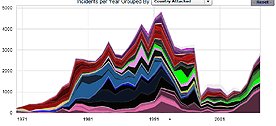
The Global Terrorism Database (GTD) is an open-source database including information on terrorist events around the world from 1970 through 2010 (with annual updates planned for the future). Unlike many other event databases, the GTD includes systematic data on domestic as well as international terrorist incidents that have occurred during this time period and now includes more than 98,000 cases. Learn more
The GTD Data Rivers is an interactive visual exploratory tool that allows users to investigate temporal trends in terrorism in the Global Terrorism Database (GTD). The GTD Data Rivers aggregates important variables from the database and visualizes them as a comprehensible stack chart.
01/31/1999: A British oil worker employed by U.S.-owned Hunt Oil was kidnapped by unknown tribesmen in an unnamed location in Yemen. The victim was released six hours later. No further information was available on this incident.
01/31/2004: A suicide car bomb detonated outside of a police station in Mosul, Iraq, killing nine people, including policemen and civilians, and wounding forty-five. No group claimed responsibility for the attack.
Our understanding of terrorism was forever transformed by the events of September 11, 2001. As we approach the 10th anniversary of those attacks, this new release of the Global Terrorism Database (GTD) marks a milestone in our collective knowledge of terrorist activity. For the first time, we have information spanning four decades on both domestic and international terrorist attacks from around the world.
I’m sure we’re all very tired by now of the Osama bin Laden nonsense, I know I am, and I really wish it would just go away. Sadly, that seems an unlikely prospect in the near future.
You’re probably aware that yesterday, Sat. 7th May 2011, the US government released “new” videos of ‘bin Laden’ that they claimed were part of the haul from the ‘compound’ in Pakistan, which, by the way, is very conveniently scheduled for destruction.
These new videos include footage that is similar to previous ‘bin Laden’ tapes, but also include footage of some guy sitting in a room watching news reports about Osama bin Laden. The US government and the fawning Western media are claiming that the guy sitting on the floor watching television is Osama bin Laden in his ‘compound’ and that the video could have been made as recently as Spring 2011. The problem is that we only get to see the man sitting on the floor from the side, there are no front-on shots that would allow us to see the man’s face and ascertain whether or not he looks anything like bin Laden and there is no audio (apparently it was edited by the Pentagon). Again, this is very convenient, and I think you will agree that, even from the side-on angle, the man on the floor does not look like any of the images of the person we know to be the real bin Laden.
But the real smoking gun is to be found in the videos allegedly taken from the Pakistan ‘compound’ and which provide higher resolution images of a man who appears to be the same person that appeared in a ‘bin Laden’ video released in 2007.
I’ve taken a few screen shots of the ‘older’ ‘new’ videos of ‘Osama’ in his fancy duds, and I’d like to do a little nose, ear and shoulder comparison with images of the real bin Laden:
Here’s an image of the real bin Laden:
And here’s a screen shot from one of the ‘new’ videos from the above CNN report:
Is this the same person?
Consider the two noses:
The real bin Laden’s nose
‘New’ bin Laden’s nose
But here’s the real smoking gun that, in a sane world, would put an end to all of this CIA psy-ops nonsense: bin Laden’s left ear:
Here’s the offending ear in a new video that we are told was recovered from the ‘compound’:
A rather petite shell-like ear for a ‘terror mastermind’
And here it is on the real bin Laden:
As you can see, the real bin Laden has a pronounced deep and flattened helix (the top outer rim of the outer ear). Whereas the ‘new’ ‘bin Laden’ has a rather petite ear (quite the envy of all in the psy-ops division of the CIA I’d say).
In fact, both of the real bin Laden’s ears have this characteristic. Here’s the right one:
Right ear showing the same flattened helix
It’s pretty astounding that the CIA would be so cavalier as to release videos that can so easily be proven to feature someone other than the real Osama bin Laden. Then again, perhaps this is indicative of the contempt with which the CIA and US government consider the general US, and to a lesser extent world, public. I think we can safely assume that the US government and all of those behind the phony ‘war on terrorism’ (which is clearly a global war of imperial conquest) and the 9/11 attacks believe that there is little if anything that the public will not accept as long as it comes from official sources. So far, the public has done nothing to suggest that this belief is ill-founded.
In short, and once again, you are being sold a monstrous lie. And you can have no doubt that believing lies always carries consequences for the believers. The seriousness of the consequences depends on the seriousness of the lie. Given that the lie that is the official narrative of the ‘war on terror’ implicates the believers in the murder of 1.5 million Iraqi and Afghan citizens, 3,000 US citizens, the torture of thousands of innocent people and the destruction of civil liberties the world over, they may want to reconsider their position.
Scents that make you trackable, indoors and out. Nanocrystals that stick to your body, and light up on night-vision goggles. Miniradar that maps your location on Google Earth.
You can run, but you’ll learn it’s hard to hide from a new range of military tech.
The Defense Department calls it “tagging, tracking and locating,” or TTL, this business of finding and following high-value targets on the battlefield. Ever since SEAL Team 6 took out Osama bin Laden, we’ve learned a lot about the technology used by special operators to find and reach their targets, from stealth helicopters to biometric identification devices. TTL gear, though, ranks among the spookiest Special Operations’ extremely spooky arsenal.
Al-Qaida says it found spies using infrared beacons to call in drone strikes in Pakistan. A Pakistani Taliban commander claims the United States puts tracking “chips” in cellphones, in order to train Hellfire missiles on militants. But these aren’t the only technologies that can to secretly track people.
With one technology, trackers might not even need to see you to get a fix on your location. Like bloodhounds on the hunt, they can smell their way to you. Tracer Detection Technology Corp. marks targets with a paraffin wax crayon, filled with a perfluorocarbon, a thermally-stable compound used in everything from refrigerators to cosmetics. The perfluorocarbon’s vapor can then be tracked with sensors, such as a gas chromatograph. The smell lingers for hours. Think locking yourself in a room with the windows closed or removing the tag will help? Too bad, you still reek. According to a research report submitted to the Justice Department (.pdf), the perfluorocarbon tracers can “permeate closed doors and windows, containers and luggage,” and even give you away for a while after a tagged item is removed.
Over the years, the company has received a number of research contracts from the Navy. But Tracer president Jay Fraser won’t say much about how those projects have gone. “Tracer is developing a unique TTL capability that will make it very difficult for enemy and criminal enterprises to operate,” he e-mails Danger Room. “The nature of our current and pending customers makes it hard for us to answer the rest of your questions.”
Now a second tracer: Imagine walking up to a target and patting him on the back with a clear liquid on your hand. He might never notice it, but you’d be able to see — and follow — him from a distance using night vision goggles. Oregon-based Voxtel makes a product, “NightMarks,” that can do just that. NightMarks are tiny nanocrystal quantum dots that can be hidden in clear liquids and seen only through a sensor like night-vision goggles.
How do these tiny dots work? “You can change the optical properties of materials by making them small on the order of a nanometer in size,” Voxtel CEO George Williams tells Danger Room. “When they get down to that size, they have quantum-confinement effects that cause their absorption and emission properties — the light they absorb, the light they put out — to change,” he says. “And so using that, you can make all sorts of spectral barcodes that allow you to identify it and track.”
Williams is tight-lipped about Voxtel’s relationship with the Defense Department and the military applications of its technology. However, a quick look at one 2008 Voxtel contract with the Navy indicates that the Department already understands how useful the technology can be for tracking targets. The contract asks for “covert microtaggants composed of nanocrystals” visible through sensors like night-vision goggles to “enable war fighters the ability to track entities buried in urban clutter.”
Another company has proposed a somewhat counterintuitive solution for military tagging: making sure its signal decays. You might think that being able to see a taggant signal for as long as possible is always a good thing, but according to a briefing (.pdf) from TIAX LLC, it can actually be a problem.
Leftover taggants that last for long periods of time can apparently clutter up an area with signals, and the mess can hinder a tracker’s ability to distinguish between the subjects of new and old tags. If they’re still advertising their presence long after usefulness, opponents might also be able to find and reverse-engineer the material. To get around the problem, the briefing mentions that TIAX is working on “customizable degradable taggants” — exact composition unspecified — that will lose their signal over time.
Other technologies are useful in defensive tracking, such as for perimeter security on small firebases. SpotterRF, makes a small radar-sensor system, the SpotterRF M600, that’s about the size of a small netbook computer and can conveniently point out humans creeping up on your position on Google Earth. The M600 uses radio waves in the X band that can detect walkers up to 1,000 meters [0.62 miles] and vehicles as far away as 1,500 meters. It integrates with Google Earth by using its own built-in GPS to fix the device’s position and overlay tracked targets onto the mapping service.
The effect, a company rep e-mails, is “like being able to stick a GPS tracking device on someone without having to come anywhere near the person or vehicle.” It’s yet another way to hunt someone down who might not want to be hunted.
Above:
Micro Radio Transmitter
Oak Ridge National Laboratories developed this micro-miniature radio frequency transmitter (above). It’s smaller than a dime, and has a range of three kilometers [1.9 miles].
Morgan O. Reynolds was a professor emeritus at Texas A&M University and former director of the Criminal Justice Center at the National Center for Policy Analysis headquartered in Dallas, TX.
He served as chief economist for the United States Department of Labor during 2001–2002, George W. Bush’s first term. In 2005, he gained public attention as the first prominent government official to publicly claim that 9/11 was an inside job, and is a member of Scholars for 9/11 Truth.
Glad to see these kind of people speaking out!
Iraqi policemen walk through debris at the central jail in Basra. Photograph: Nabil al-Jurani/AP
British troops used tanks last night to break down the walls of a prison in the southern Iraqi city of Basra and free two undercover British soldiers who were seized earlier in the day by local police.An official from the Iraqi interior ministry said half a dozen tanks had broken down the walls of the jail and troops had then stormed it to free the two British soldiers. The governor of Basra last night condemned the “barbaric aggression” of British forces in storming the jail.
Aquil Jabbar, an Iraqi television cameraman who lives across the street from the jail, said dozens of Iraqi prisoners also fled in the confusion.
In a statement last night the defence secretary, John Reid, said: “I am pleased to be able to say that the British servicemen who were seen being injured in the graphic photographs are being treated for minor injuries only and are expected to return to duty shortly. We remain committed to helping the Iraqi government for as long as they judge that a coalition presence is necessary to provide security.”
A Ministry of Defence spokesman said: “We have not had confirmation of the full details of this. We’ve heard nothing to suggest we stormed the prison. We understand there were negotiations.”
In a day of dramatic incidents in the heart of the British-controlled area of Iraq, the two undercover soldiers – almost certainly special forces – were held by Iraqi security forces after clashes that reportedly left two people dead and threatened to escalate into a diplomatic incident between London and Baghdad.
The soldiers, who were said to have been wearing Arab headdress, were accused of firing at Iraqi police when stopped at a road block.
In another incident an angry crowd attacked a Warrior armoured personnel carrier with petrol bombs. A British soldier was forced to flee from his burning vehicle.
Muhammad al-Abadi, an official in the Basra governorate, told journalists the two undercover soldiers had looked suspicious to police. “A policeman approached them and then one of these guys fired at him. Then the police managed to capture them.”
Senior British officials said the Iraqis who attacked the Warrior armoured vehicle had prepared their petrol bomb attack before the incident involving the two undercover soldiers. The origins of the attack on the Warrior, they say, lay in events the previous day when about 200 members of the al-Mahdi Army, a militia headed by the radical Shia cleric Moqtada al-Sadr, made a show of force in Basra, blocking roads in the city and demanding the release of their local commanders.
What’s Erik Prince been doing since he sold off Blackwater, the infamous mercenary company he founded and turned into a juggernaut of the private security world? His shadiest, most morally-compromised guns-for-hire scheme yet.
Prince moved to Abu Dhabi last year as legal and governmental scrutiny of Blackwater intensified. “I’m done. It’s all sold or shut down,” he told journalist Robert Young Pelton shortly before boarding his farewell flight. “I’m getting out of the government contracting business.” And provided he meant the U.S. government, that vow has stood the test of time. But his adoptive country is a different story.
Documents obtained by the New York Times indicate that Prince rebooted his efforts in private security to build a praetorian army of mercenaries for the ruling clique in the United Arab Emirates. His new company, Reflex Responses, hires a mixture of Colombian soldiers of fortune and South African vets of Executive Outcomes, the pre-Blackwater merc firm that fought nasty counter-guerilla wars in Angola and Sierra Leone. That’s right: forces from Christian nations hired to protect Muslim leaders, possibly against their own people. And in keeping with Prince’s history, if Reflex is doing business legally — from the perspective of U.S. law — it’s only barely so.
The tiny UAE is a financial giant on the Persian Gulf, drenched in oil and unconcerned with political liberty for its wealthy citizens. It lives in fear of Iran. And its military keeps only about 65,000 men under arms. It’s had a murky interest in helping Somalia contain its piracy problem — another effort rumored to involve Prince. And so far, the Mideast uprisings haven’t touched the UAE, but you never know. Its ruling sheikhs are used to paying foreigners to do their dirty work: its labor force is imported. Now it prefers to apply that model to its security needs.
That’s where Prince comes in.
Under terms of Reflex’s contract with the consortium of monarchies, obtained by the Times, Prince will build, train and field a battalion of foreign auxiliaries “independent of formal command and support structures throughout the UAE.” They’re supposed to be for “internal” defense, conducting “cordon and search,” “stability and support operations” and general “security operations.” Only “leaders” of the force need be proficient in English; the contract doesn’t say anything about the mercs speaking Arabic.
Consider for a second that this is a force comprised of mercs from Christian countries operating on Islamic soil. The Executive Outcomes veterans — not exactly known for their subtlety; they were involved in a coup attempt in Equatorial Guinea — will staff a quick reaction force, able to seize key infrastructure and put down a protest that spins out of control. What could go wrong?
Indeed, Reflex is supposed to provide a full survice military in miniature. It’s going to have “aviation support capability,” with “rotor and/or fixed wing aircraft,” capable of medevac and “basic” intelligence, surveillance and reconnaissance. “Advanced mission training” will include “sniper,” explosive ordnance disposal, “scout/surveillance [and] military working dog” responsibilities. There’s even a private navy, tasked with “small boat operations and seaman ship, Maritime Interdiction Operations (MIO), Securing Oil Delivery Stations/Platforms” and more.
That’s a lot to ask of 800 people. It also begs the question of why the UAE would continue to invest in its elite military units, which have served in Afghanistan, when there’s this new hired Army to use.
The contract doesn’t specify what gear they’re going to use. But it’s going to need ships, helicopters, transport planes, communications gear, fuel depots or access to existing ones, a motor pool of trucks and, of course, guns. They’ve built a barracks in the desert to house and train the new Reflex force.
Because of all this gear and all this construction, it’s surprising that the effort — which the contract indicates began in June 2010 — stayed secret for this long. But it’s astonishing that someone leaked the Times the actual contract Reflex holds with the UAE. Is there internal dissent within Reflex already?
Prince’s new gig also might run afoul of U.S. laws prohibiting citizens from trailing foreign militaries. That kind of work requires a government license. The State Department wouldn’t say if Reflex has such a license, and told the Times it’s “investigating” to see if Reflex is on the right side of the law.
Some aspects of Reflex make it seem like Prince is getting the old band back together. One of his top deputies is Ricky Chambers. Chambers, a former FBI agent, ran the Blackwater subsidiary Paravant — whose guards in Afghanistan signed for guns under the name “Eric Cartman” and shot Afghan civilians dead during a 2009 vehicle accident.
Mideast leaders are reeling from the reformist uprisings. So far, only Moammar Gadhafi has hired mercenaries to backstop his rule. And the UAE’s interest in Reflex predates the current Mideast uprisings. But while it might be crazy to hire South Africans and Columbians to break up protests by Muslims calling for democratic change, desperate autocrats have done far crazier things. They surely know how to get in touch with Erik Prince.
THE US army is planning to field “rubber bullets” for machine guns. Military officials claim the ammunition will allow them to more effectively quell violent protests without loss of life, but human rights campaigners are alarmed by the new weapon.
The final design for the XM1044 round has not been selected, according to an order placed on the Federal Business Opportunities website last month, but the Joint Non-Lethal Weapons Directorate has been working on a ring aerofoil projectile for some years. The round is a hollow plastic cylinder 40 millimetres across, looking something like a short toilet-paper roll. In flight its shape generates lift, giving it a longer range.
The army’s existing crowd-control rounds are single shots fired from handheld grenade launchers with a range of about 50 metres – the XM1044 would double this range. It would be supplied in belts for the Mk19 grenade launcher, a truck-mounted weapon that can fire almost six rounds per second. The Mk19 has been exported to some 30 countries, including Egypt.
“The US army has a requirement for a rapid-fire non-lethal capability,” says Ken Schulters, project manager for close combat systems at Picatinny Arsenal in New Jersey. “All currently fielded non-lethal ammunition is single shot.”
Firing rapidly at long range is likely to be dangerously inaccurate, says Angela Wright of Amnesty International. “Such a weapon system would allow for a burst of non-accurate fire at a crowd, with high risk of hitting bystanders, ricochets and of hitting vulnerable areas of the body,” she says.
Despite being hollow and plastic, if a round were to strike someone in the head, it could severely injure or kill them, she adds.